There are certain films, as there are certain houses, certain faces, certain half-remembered symphonys, that possess about them an atmosphere not wholly explicable by their component parts. One may catalogue the timber and the stone of such a house, may measure its windows and its doors, and yet the dread and the beauty of the thing will elude the measuring. So it is, I confess, with Ridley Scott’s Kingdom of Heaven. A film that upon its release was regarded by many as a mere pageant of swords and sand, and which time has revealed to be something considerably graver. A meditation upon conscience, upon faith corrupted and faith redeemed, and upon the terrible arithmetic by which men justify the spilling of blood in the name of a peace they cannot themselves define. I intend, in the pages that follow, to walk us through the smoke and the psalm-song of this film, and to ask what it is, precisely, that we might still learn from it.
I. A Divided Heart
Let us begin, as the film itself begins, in a village of dark skies and despair, where a blacksmith named Balian labors at his forge with the flat persistence of a man who has just buried something more than he believed his heart could bear. He has, we soon learn, buried a wife. A wife who took her own life, and whose head, according to the custom and cruelty of the Church of that age, was severed from her body and her necklace hung about Balian’s neck as a mark of her damnation, that all might know a suicide when they saw the rot of it. It is a monstrous image, and Scott does not flinch from its monstrosity. Here, at the very outset, is planted the seed of every conflict that will flower, dark and thorned, through the whole of the picture: a man who cannot reconcile the God he has been taught to love with the God who permits such cruelties in His name.
I confess that I find in Balian a figure of peculiar and haunting sympathy, for his is not the simple torment of the villain nor the simple radiance of the saint, but that far more terrible condition of the soul suspended between the two. A soul that hears within itself two voices, and cannot with certainty say which is angel and which is fiend. He kills a priest, his own half-brother, no less in a moment of grief and rage, and flees not merely the law of men but, one suspects, his own conscience, which pursues him across the whole of Europe and the whole of Palestine like a hound that will not be called off. And yet this same man, stained with fratricide, becomes in Jerusalem a builder of wells, a defender of the defenseless, a knight who will not raise his sword against the helpless though the whole machinery of holy war demands that he do so. Balian’s arc, then, is not a redemption in the tidy Sunday-school sense, not a wiping away of sin by a single grand gesture but something closer to the truth of how conscience actually labors. Slowly, through the small and unglamorous acts of digging irrigation ditches and knighting farmers, a man reconstructs for himself a private cathedral of meaning after the public one has been burned to the ground. What we learn from Balian, I think, is this: that the conflict between doubt and duty is not resolved by triumph but by practice. By choosing, again and again, in the unglamorous particulars of each single day, to act as though virtue mattered, even when the heavens above give no sign that they are watching.
II. the Leprous Saint
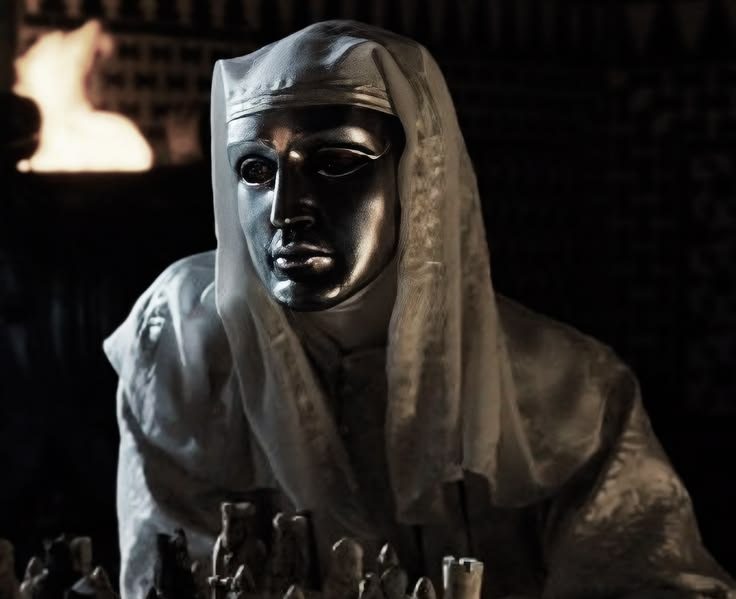
If Balian is the film’s divided heart, then King Baldwin IV is very nearly its soul, and here I must pause, for I do not think I exaggerate when I say that few figures in the whole of modern cinema have moved me so profoundly as this leper king. His face concealed behind a mask of beaten silver, his voice emerging as though from some sepulchre of patient and terrible wisdom. Consider the peculiar horror of his condition, a young man, crowned before his majority, his body rotting by inches beneath his royal vestments, and yet possessed of a moral clarity that shames every unblemished courtier who schemes about his throne. There is something almost unbearably poignant in this arrangement, that the one soul in all of Jerusalem most fit to reign is the one soul whom disease has rendered, in the eyes of the age, most unfit to be looked upon.
Baldwin’s greatness lies not in what he does, for disease steals from him even the power to act, but in what he refrains from doing. He restrains the hawkish Guy de Lusignan and the savage Reynald de Chatillon from provoking a war they cannot win; he negotiates peace with Saladin not from weakness but from a humility so total it becomes its own species of strength; and in the film’s most quietly devastating gesture, he removes his mask before Balian only once, in shadow, so that we, like Balian, are permitted to feel the weight of his suffering without being permitted to gaze upon it. Here, I would suggest, is the film’s great and unfashionable argument. That true authority is not the loud authority of the crusader’s roar but the whispered authority of a dying man who has made peace enough with his own mortality that he can spend his final strength making peace for others. Baldwin teaches us, teaches us still, in an age no less addicted to the theater of strength than his own, that humility exercised from a position of power is a rarer and a more difficult virtue than courage exercised from a position of weakness, and that the truest kings are very often those who understand themselves, first and foremost, as already dying men.
III. Shadow and Gold
I turn now from the matter of the film to its manner — for it would be a grave omission were I to speak only of what Kingdom of Heaven argues and say nothing of how magnificently it conjures the world in which that argument unfolds. Ridley Scott has always possessed a director’s eye for the sublime in the geographical sense, and here that eye is turned upon the deserts and the fortified cities of the Levant with a rigor that borders on the devotional. The armies that gather beneath Jerusalem’s walls are not the sanitized, weightless hosts of lesser epics; they possess mass, they possess dust. The cinematography bathes the film in the amber and ash tones of a world lit by torch and desert sun alike, so that even the film’s quieter interludes carry within them the same scale, the same sense of a single soul dwarfed by circumstance, that characterizes its battles.
And it is in this marriage of the intimate and the immense that the film achieves its truest atmosphere. For what is atmosphere, in the end, but the sensation that the small human drama we are witnessing is unfolding beneath the indifferent gaze of something vastly larger than itself? The siege of Jerusalem, when at last it comes, is orchestrated with a terrible choreography. The catapults arching their burning cargo against a bruised sky, the walls shuddering under assault, the desperate improvisations of a citizenry armed more with faith than with steel. In this it recalls nothing so much as those old paintings of the Last Judgment in which the damned and the saved alike are rendered with the same meticulous, pitiless attention to detail. Few films of the epic genre, before or since, have so successfully made their scale feel like a moral weight upon the viewer rather than a mere technical accomplishment.
IV. The Faith That Wounds and the Faith That Heals
It is here, perhaps, that I arrive at the film’s most delicate and most necessary labor, for Kingdom of Heaven undertakes nothing less than the dissection of Christianity itself in an age of holy war, and it performs this dissection with a steady hand. The film does not spare us the corruptions committed beneath the cross, we see the Patriarch of Jerusalem, bright in his golden vestments, counsel the massacre of Muslim men, women, and children with the same casual cruelty a man might use in ordering the slaughter of livestock. We see Reynald de Chatillon violate a truce and slaughter a caravan of pilgrims for the sheer intoxication of holy violence; we hear, again and again, the invocation of God’s name as a justification for acts that no ‘god’ worth worshipping would sanction. It would have been easy, and it would have been cheap, for the film to rest here. To indict the faith entire and call the matter settled.
But Kingdom of Heaven does not rest here, and it is in this refusal that its moral seriousness is proven. Against the Patriarch’s greed it sets the humble priest who confesses to Balian his own unworthiness to counsel him, a man who understands, in his own imperfection, the difference between the institution and the divine it claims to serve. Against Reynald’s savagery it sets Baldwin’s mercy. Against the crowd’s bloodlust it sets Balian’s own insistence, in the film’s climactic address to the desperate citizens of Jerusalem, that what makes a man worth more is not his lineage or his creed but his conduct, his sense, his courage, his own virtues. The film’s final vision of a Christian is not, therefore, a man who has abandoned his faith beneath the weight of its institutional sins, but a man who has sifted through the wreckage of that institution to salvage the small kernel of genuine goodness that first justified its existence. Mercy over vengeance, protection over conquest, the well dug for a stranger over the sword raised against him. It is a portrait, I would argue, not of faith destroyed but of faith purified by fire, and there is a lesson in this for any age, our own included, in which institutions claiming divine sanction so often betray the very virtues they were founded to protect.
V. The Blood Beneath
I come, at the last, to the matter that perhaps most sets this film apart from its epic counterparts, namely, its unflinching insistence that even a war fought in defense of the innocent, even a cause dressed in the vestments of righteousness, remains at its core an orgy of horror from which no participant emerges unstained. The siege of Jerusalem is framed, ostensibly, as the defensive stand of the just. Balian and his ragged company protect a city of civilians against Saladin’s advancing host. And yet the film permits us no easy comfort in this justice. We see men burned alive by flaming pitch, we see Balian himself reduced by the necessities of siege warfare to ordering acts he would, in any other circumstance, call atrocity. There is no glory lingering in the aftermath of Scott’s battles, only an exhaustion.
This is, I think, the film’s final and most difficult instruction. That the moral clarity of a cause does not purchase moral cleanliness for those who fight it. Even Saladin, portrayed with a dignity and restraint rare for a Hollywood epic of that era, is shown honoring the fallen even as he prepares to besiege them. A gesture that reminds us the horror of war respects no boundary of righteousness, that it stains the hands of the just as surely as it stains the hands of the wicked. In an age such as ours, no less prone than Balian’s to the seductive rhetoric of the “just war,” this seems to me a lesson we forget at our peril, that a cause may be righteous and its execution still be a catastrophe, that the dead do not distinguish between the armies that killed them by the nobility of the banners those armies carried, and that any people who go to war, however justly, owe it to their own souls to remember what, precisely, that war cost, and to whom.
Conclusion: The Kingdom We Still Build
And so we return, as one always returns from the contemplation of a great and melancholy work, to the question of what, if anything, remains with us once the final image has faded and the theater has fallen silent. Kingdom of Heaven offers us no comfortable answer, no tidy moral to be folded away and forgotten. It offers instead a mirror, silvered like the mask of a king, in which we may glimpse our own divided hearts, our own institutions capable of both grace and atrocity, our own causes that feel just and yet exact a price we too rarely reckon. Balian, in the film’s final and quietest scene, returns to his forge. Not as a knight, not as a defender of holy cities, but as a blacksmith once again, having learned, perhaps, that the kingdom of heaven is not a city to be defended with the sword but a conduct to be practiced with the hands. It is a small ending for so vast a film, and I think it is precisely for that smallness that it endures. For it suggests, in the end, that the kingdom we are meant to build is not conquered once and held forever, but is built again, in every day we are given to build it.
Written and edited by:
Sebastian J Selonke
 Cult35.blog
Leave a comment